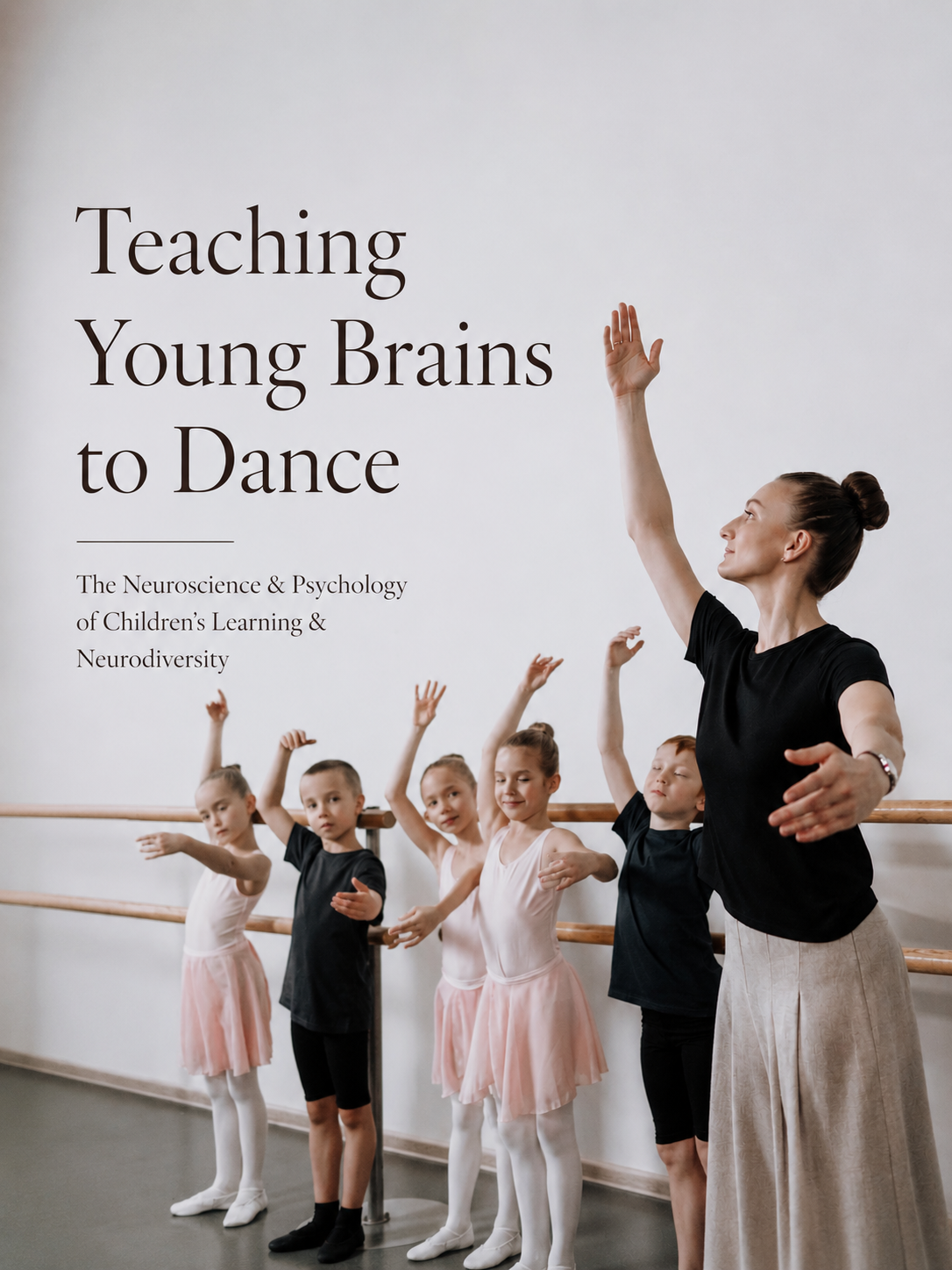
Teaching children isn’t simply about simplifying choreography.
It’s about understanding how a developing brain learns.
Have you ever taught a class where one child remembers everything instantly, another seems unable to follow even simple instructions, one can’t stop moving, another avoids participating altogether, and someone ends the class saying, “I’m just not good at dancing”?
Most dance teachers assume these children simply need more discipline, more repetition, or more practice.
But often, that’s not the problem.
Children’s brains are still developing. Their attention, memory, emotional regulation, coordination and executive functioning mature at different rates. Add neurodiversity, including ADHD, autism, dyslexia, dyspraxia and sensory differences, and it becomes clear that no two children learn movement in exactly the same way.
Yet most dance teachers receive little or no training in child development, learning psychology or neuroscience.
As a result, many children become frustrated, lose confidence, disengage from class, or eventually stop dancing altogether—not because they lack talent, but because they were never taught in a way their brain could understand.
Imagine being able to recognise why a child is struggling within minutes, adapt your teaching on the spot, keep the entire class engaged, and help every child experience success.
That’s exactly what this workshop is designed to teach.
Using the latest research in developmental neuroscience, psychology, motor learning and neurodiversity, you’ll discover practical strategies to create classes that are more engaging, more inclusive and significantly more effective for every child.
Throughout the workshop, we’ll analyse real teaching situations, discuss your own students and challenges, and every participant will receive personalised advice tailored to their teaching environment and age group.
In this workshop, you’ll explore:
- How children’s brains develop through movement
- Why young children learn differently from teenagers and adults
- Attention, memory and executive functioning in dance classes
- Why some children appear distracted, overwhelmed or “don’t listen”
- Understanding ADHD, autism, dyslexia, dyspraxia and sensory differences in dance
- How to adapt activities without making children feel different
- Building confidence instead of perfectionism
- Giving corrections children can actually understand and remember
- Managing emotional regulation, frustration and challenging behaviours
- Creating motivating classes that keep children engaged from beginning to end
- Why some children lose confidence, stop progressing or drop out—and how to prevent it
- Structuring lessons that maximise learning while supporting every child’s unique way of processing movement
- Practical neuroscience and psychology strategies you can implement immediately
By the end of this workshop…
You’ll understand what is happening inside a child’s brain while they learn movement, giving you the confidence to support every learner—not just those who naturally excel.
You’ll leave with practical, evidence-based tools to structure some of the most engaging, inclusive and effective children’s dance classes you’ve ever taught. Your teaching will become more adaptable, your students will feel more understood, and you’ll be equipped to help children build confidence, develop a lifelong love of dance, and reach their full potential regardless of how their brain learns.
Whether you teach ballet, contemporary, jazz, commercial, creative movement or recreational dance, this workshop will fundamentally change the way you teach children—helping you move beyond simply teaching steps to understanding the developing brain behind every movement

There are no reviews yet.